
- Telecom and MDF/IDF rooms face slow, smouldering cable fires that produce smoke long before flame, unlike faster server-room fires.
- Air-sampling aspirating detection should be the default in an equipment room, not an optional extra.
- Water, powder, and CO2 stay out; a clean agent designed under NFPA 2001 is the suppression option.
- Design and maintenance run through Dubai Civil Defence and the UAE Fire and Life Safety Code, applying NFPA 76 and NFPA 2001.
- Enclosure integrity matters even in a small, cable-dense MDF room.
An overheating cable termination in an MDF room does not roar. It ticks along for hours, sometimes days, pyrolysing PVC insulation and pushing a thin haze of smoke into the airflow before anything ignites. That slow build is the whole reason telecom room fire suppression Dubai projects should be designed around detection first and the gas cylinder second.
A telecom or equipment room is not a small server room. Same building, same clean agent brands on the wall, a different fire.
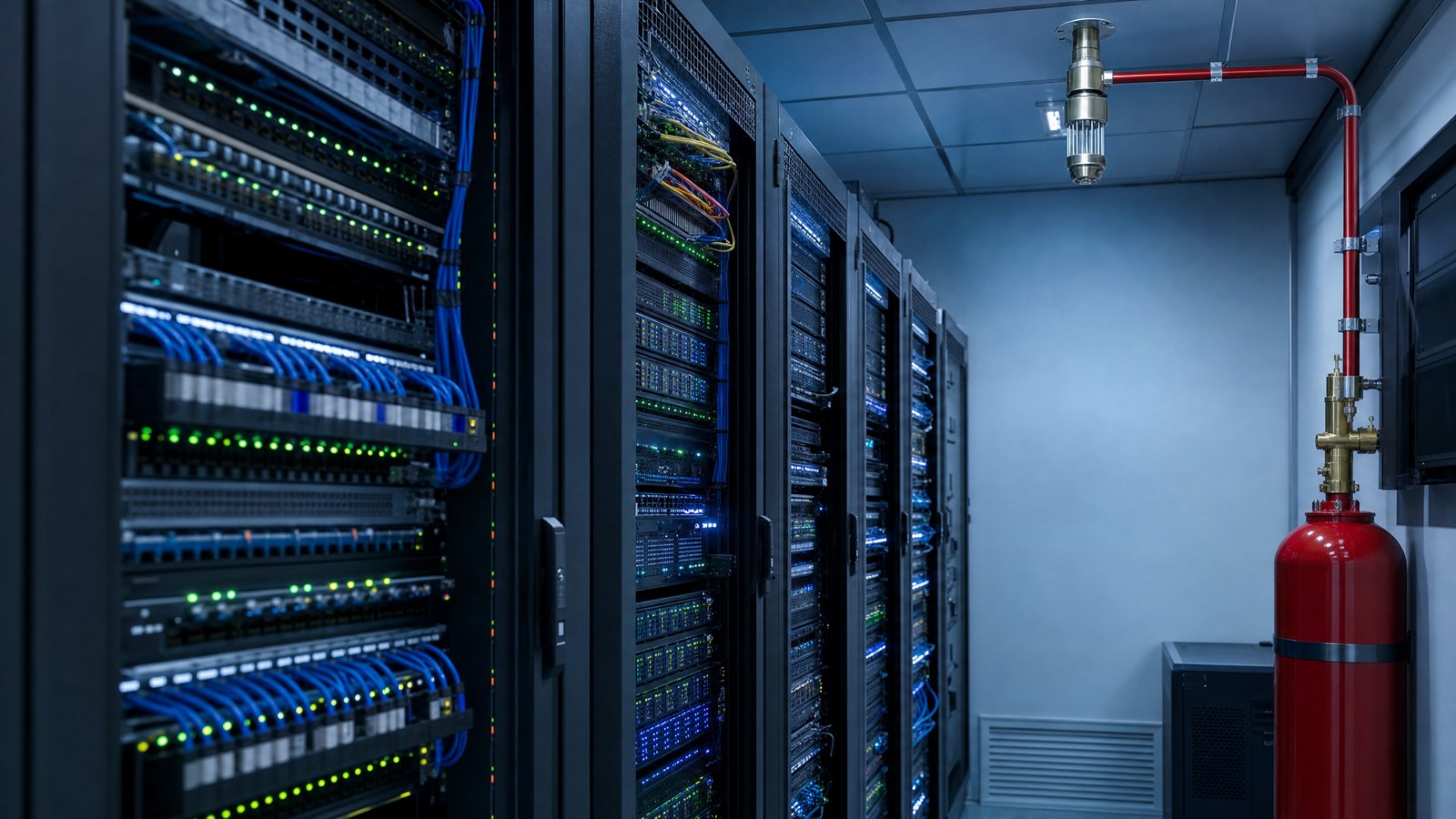
Telecom Room Fire Suppression Dubai: Why the Fire Behaves Differently
The equipment in an MDF or IDF room is mostly passive. Copper cross-connects, fibre patch panels, punch-down blocks, a handful of active switches, and the power feeds that serve them. Heat load per rack is usually lower than a packed compute rack, but the room runs continuously and the cabling density is high.
Fires here tend to start low and slow.
A loose connector, a failing power supply, or an overloaded feed heats insulation past its ignition point over a long window. The first product is smoke, not flame. Cooling airflow then dilutes that smoke and moves it away from any ceiling spot detector, which is exactly where a conventional smoke head expects to find it.
A server room fails differently: denser heat, faster escalation, and airflow measured across full rack rows.
How an MDF/IDF Room Differs From a Server Room
The design inputs change even when the agent does not.
| Design point | Telecom / MDF-IDF room | Server / data room |
|---|---|---|
| Typical fire signature | Slow overheating cable and insulation; smoke long before flame | Faster-developing rack or PSU fire; higher heat release |
| Heat load | Lower steady load, dense passive cabling | High continuous load, dense compute racks |
| Primary risk to guard | Service continuity for a lifeline network | Data integrity and uptime |
| Detection priority | Very early warning, air-sampling suited to airflow | Early warning plus total-flooding readiness |
| Suppression | Clean agent sized to the enclosure, no water | Clean agent total flooding, no water |
| Governing references | NFPA 76 with NFPA 2001 and the UAE code | NFPA 2001 and the UAE code, NFPA 75 practice |
Both rooms rule out water, powder, and CO2 for the same reasons set out in our server room fire protection guide. What shifts is where the engineering attention and the budget should land.
The Case for Aspirating Detection in Equipment Rooms
Here is the stance. For a telecom or equipment room, air-sampling aspirating detection should be the default, not an upgrade line item.
The reasoning is physical. An aspirating system draws room air through a network of sampling pipes to a central detector that is far more sensitive than a spot head. In a space where cooling airflow scatters early smoke, actively pulling air to the sensor is what buys the early warning window. NFPA 76 is built around this idea, defining very early warning fire detection for telecommunications facilities precisely because those fires announce themselves as smoke long before flame.
That window matters more in telecom than almost anywhere. A lifeline network going dark is its own emergency. Catching a hot connection while it is still smouldering means a technician can isolate one circuit, instead of the room flooding with agent and taking the whole facility offline.
The trade-off is honest. Aspirating detection costs more up front, the sampling pipe layout has to be tuned to the room's real airflow, and the detector needs periodic sensitivity calibration to stay accurate. It is not fit-and-forget. For a room whose job is to keep a building connected, that maintenance overhead is a fair price, and it is cheaper than over-specifying suppression while a slow fire goes unseen.
In practice, the equipment-room fires we get called to inspect rarely started with an open flame. A terminal had been running hot for days, and the only early sign anyone could have caught was smoke drifting in the airflow.
QSERV's DCD-approved team designs detection and clean agent suppression for telecom and equipment rooms across Dubai.
What DCD and NFPA Expect
Design and installation still run through Dubai Civil Defence approval. The UAE Fire and Life Safety Code of Practice sets the requirements a Dubai Civil Defence approved contractor works to, from plan submission through commissioning.
Gas suppression follows NFPA 2001 for clean agent systems. The agent, usually FM200 (HFC-227ea) or Novec 1230 (FK-5-1-12), has to reach design concentration quickly and hold it long enough to stop re-ignition, and the enclosure has to be tight enough to keep it there. Detection design draws on NFPA 76, the standard for fire protection of telecommunications facilities.
> The gas is the same. The detection is not. In a lifeline room, catching the fire early is the plan, and the agent is the last resort.
One requirement people forget in small rooms is enclosure integrity. A cable-dense MDF is full of penetrations, and every unsealed cable entry is a leak path that lets agent drain out before it does its job. Seal the room, then prove it holds.
Suppression sizing follows the same clean-agent calculations as a server room, so the FM200 suppression fundamentals carry across. The difference is the detection layer you put in front of it.
Start with one honest question about the room you run: would your current detection catch a smouldering cable before it flames? If you are not sure, get the MDF or IDF assessed against NFPA 76 and the UAE code, and size the clean agent around what the enclosure can actually hold. QSERV's fire and MEP services team can survey the room and quote both layers together.


