
Fire spreads through the gaps you cannot see. Ductwork is one of the biggest. It runs through walls and floors all over a building. With no guard, it would carry fire and smoke from room to room. Fire dampers close those ducts. But a damper only helps if it still shuts. That is what testing proves.
This guide keeps it simple. How fire and smoke dampers are checked in Dubai. Why access panels matter. And what Dubai Civil Defence (DCD) wants on file.
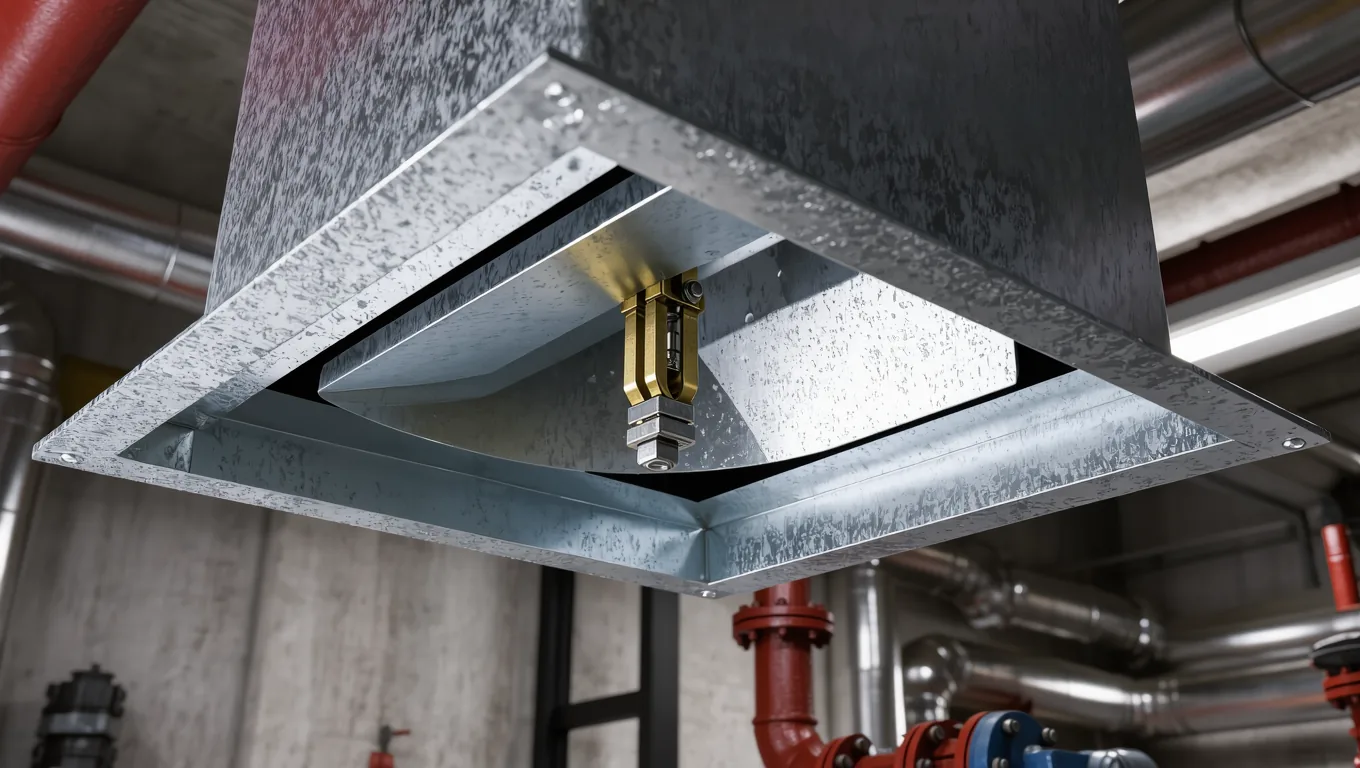
What a Fire Damper Does
A fire damper sits in a duct. It is placed where the duct crosses a fire-rated wall or floor. In normal use, it stays open and air flows. When a fire starts, it closes. A link melts at a set heat. Or a motor drives it shut on a signal.
Once shut, the damper blocks the duct. That keeps fire and smoke in one zone. They cannot travel through the building. It is a quiet part of the fire plan. And an important one.
There are two main types:
- Fire dampers close to stop flames and heat where a duct crosses a fire wall.
- Smoke dampers close to stop smoke. They are often run by the fire alarm.
Some units do both jobs. They are combined fire and smoke dampers.
The Drop Test
A damper can sit open for years. Dust, rust, paint, or a stuck link can stop it closing. The only way to know it works is to test it.
The drop test is simple. The tech releases the damper so it shuts fully. He checks that it seals the duct. Then he resets it to open. If it shuts and reseats cleanly, it passes. If it sticks or fails to seal, it is logged and fixed.
A common pattern is one test about a year after fitting. Then a test on a multi-year cycle. Higher-risk sites, like hospitals, are tested more often. The exact dates follow NFPA 80 and your fire strategy. So confirm them with a DCD-approved contractor.
Access Panels: No Panel, No Test
Here is the snag most buildings hit. A damper is sealed inside ductwork. With no way in, no one can reach it to test or reset it.
That is why access panels matter. A panel should sit near every damper. Then it can be opened, worked, and reset. With no access, a damper cannot be tested. And an untested damper is treated as unproven.
In many Dubai buildings, missing or painted-over panels are the main barrier. Fixing that is often the first step before testing can even start.
Where Dampers Fit
Dampers are part of how a building holds fire back. They work with fire walls, fire doors, and smoke control systems. Smoke dampers are often tied to the fire alarm. So their tests should line up with fire alarm maintenance and the cause-and-effect checks.
Dampers live in the HVAC system. So testing them well needs someone at home with both fire safety and ductwork. They are easy to miss, because they are hidden.
Keep the Records
As with every fire system in Dubai, the paperwork is part of the job. Each test should be logged. Which damper. Where. The result. And any fix. DCD wants to see that the dampers were tested and faults were fixed.
A building can have hundreds of dampers. A clear list, with locations and test dates, turns a messy system into a provable one. QSERV inspects and drop-tests fire and smoke dampers for Dubai buildings, with the records DCD expects.
Explore the Fire Damper Cluster
Each page below goes deeper on one part of fire and smoke damper compliance.
For broader services, see QSERV's Fire Systems AMC Dubai page.
Frequently Asked Questions
Q: How often should fire dampers be checked in Dubai?
A common pattern is one test about a year after fitting. Then a test on a multi-year cycle. Higher-risk sites, like hospitals, are tested more often. The exact dates follow NFPA 80 and your fire strategy. So confirm them with a DCD-approved contractor.
Q: What is a fire damper drop test?
It is a working test. The tech releases the damper so it shuts fully. He checks the seal. Then he resets it. The test proves the damper will shut and block fire or smoke when the link melts or the motor fires. The result is logged for the building file.
Q: Why do access panels matter for fire dampers?
A damper hidden in ductwork cannot be reached without a panel near it. With no panel, the damper cannot be tested. And an untested damper is treated as unproven. A panel should sit at every damper. Then each one can be reached, tested, and reset.
Q: What is the difference between a fire damper and a smoke damper?
A fire damper shuts to stop flames and heat in a duct where it crosses a fire wall or floor. A smoke damper shuts to stop smoke in the ductwork. It is often run by the fire alarm. Some units do both jobs.
Q: Who can test fire dampers in Dubai?
A skilled fire safety or HVAC contractor should do it. They must reach, work, and reset each damper, then log the result. QSERV inspects and drop-tests fire and smoke dampers as part of fire and HVAC care for Dubai buildings.


