
Warehouse fire protection UAE regulations are strict. Warehouses face unique fire risks in the UAE. High-bay racking, packed combustibles, and forklift traffic create dangerous conditions.
Add Dubai and Abu Dhabi's extreme summer heat, and a small fire can become catastrophic in minutes. Only suppression systems designed for these challenges can handle the risk.
Why Warehouses Are a High-Priority Fire Risk in the UAE
Dubai Civil Defence inspects warehouses more closely than other buildings. The reason is simple: warehouses hold more fire risk.
What is fire load?
Fire load measures the total energy from combustible materials per square metre. Warehouses have much higher fire loads than offices or retail spaces.
The storage risk
A single rack of polyethylene packaging can release energy like thousands of litres of fuel. When stacked 8-10 metres high, the heat overwhelms standard suppression systems. These systems were not built for such high-risk storage.
Three UAE-specific factors increase warehouse fire risk:
- Extreme heat: Outdoor temperatures often exceed 45 C in Dubai and Abu Dhabi. This heat speeds up combustion and can damage detection equipment in non-air-conditioned storage areas.
- Rapid logistics growth: The UAE logistics sector is expanding quickly. Many older warehouses now store materials their original fire systems were never designed to protect.
- High staff turnover: Warehouse operations often see frequent staff changes. This means fire safety training gets missed. Fire wardens may not be appointed, and evacuation drills may not happen. Workers lack the knowledge to respond effectively in emergencies.
What DCD Requires for Warehouse Fire Protection
The UAE Fire and Life Safety Code applies across all Emirates. It sets specific technical requirements for warehouse fire protection systems.
Sprinkler Systems
Warehouses above a certain size must install automatic sprinkler systems. These must comply with NFPA 13 standards.
Key design requirements:
- Commodity classification: The system design depends on what you store. Plastics, aerosols, rubber, and other high-risk materials need in-rack sprinklers plus ceiling heads.
- Rack height and layout: The design must account for rack height and aisle layout.
- Water supply: The system must sustain water flow for 60-90 minutes, depending on hazard category.
When are in-rack sprinklers required?
In-rack sprinklers become mandatory under NFPA 13 when high-risk commodities are stored above 3.7 metres.
ESFR sprinklers
ESFR (Early Suppression Fast Response) sprinklers are required for high-bay warehouses. This applies when Commodity Class IV materials are stored above 6 metres. ESFR sprinklers suppress fire at the source before it spreads through the rack structure.
Fire Alarm and Detection Systems
Your warehouse fire alarm must match the building's height and use.
Detection for high-bay warehouses
For warehouses with ceiling heights above 8 metres, standard point detectors don't work well. Smoke dilutes before reaching the sensor.
Solutions for high-bay spaces:
- Beam smoke detectors: These project an infrared beam across the building. They detect when smoke blocks the beam.
- Aspirating smoke detection (VESDA): These systems actively draw air samples from across the building. They detect fire at much lower concentrations than passive methods. VESDA is increasingly used for critical or high-value storage.
Hassantuk connection
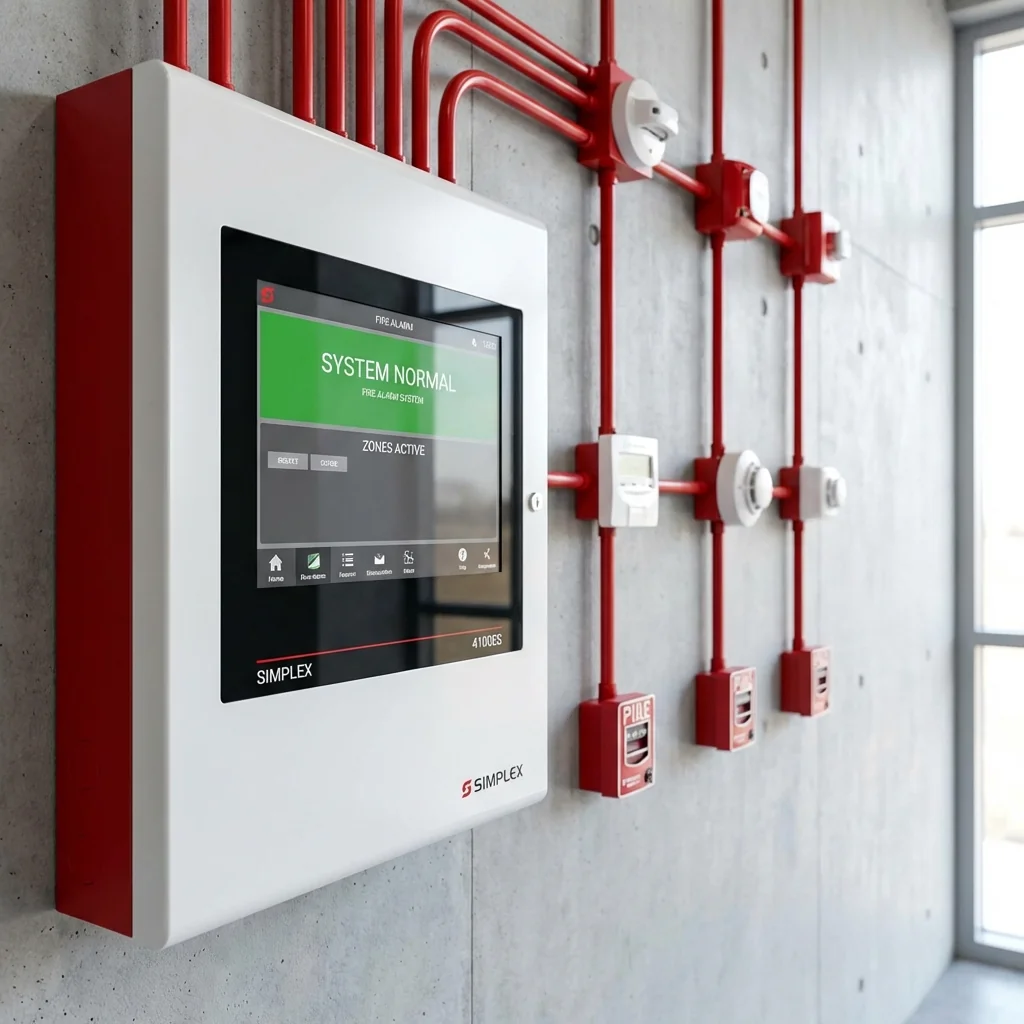
All commercial and industrial buildings in Dubai must connect fire alarm panels to Hassantuk. This is DCD's central monitoring network. It provides real-time alarm notification and immediate fire service dispatch.
Emergency Lighting, Signage, and Extinguisher Provision
Emergency lighting
DCD requires emergency lights along all exit routes. These must have a minimum 3-hour battery backup.
Exit signs
Exit signs must stay continuously illuminated. Position them so every exit route is clearly visible from anywhere in the building. This is especially important in warehouses where high-bay racking creates narrow aisles that can disorient workers during evacuation.
Fire extinguishers
Mount fire extinguishers no more than 15 metres apart throughout the facility. Use the correct type for each hazard:
- ABC dry powder: For general combustibles
- CO2: Near electrical panels and battery-charging stations
- Wet chemical: Near catering equipment
- Foam: Where flammable liquids are stored
Common Compliance Failures in UAE Warehouses
Storage too close to sprinkler heads
This is the most frequent DCD violation. NFPA 13 and DCD require 450 mm clearance below every sprinkler deflector. When pallets are stacked to the ceiling, this clearance is lost. The sprinkler's spray pattern gets blocked, leaving large areas unprotected.
Disabled fire detection
This is the second most common failure. Dust, insects, and forklift vibration cause false alarms with conventional point detectors. Some operators mute or isolate detectors instead of fixing the root cause. A DCD inspector who finds disabled devices will issue an immediate violation.
Your Civil Defence certificate will not be renewed until the full system is restored.
Other common issues
QSERV's pre-inspection audits often find these problems before they become failures:
- Inadequate in-rack protection after rack height increases
- Expired extinguisher service records
- Lapsed Hassantuk monitoring subscriptions
How QSERV Delivers Warehouse Fire Protection
QSERV Technical Services is a DCD-approved contractor. We manage the complete warehouse fire protection lifecycle across Dubai, Sharjah, Abu Dhabi, and the wider UAE.
Our process:
- Site survey and hazard classification: We assess your warehouse and classify the hazards.
- System design: We create a full system design with hydraulic calculations and shop drawings.
- DCD approval: We submit everything to DCD for plan approval.
- Installation: Our licensed engineers carry out all installation work against approved drawings.
- Commissioning: We coordinate the DCD commissioning inspection.
- Maintenance: We transition your facility into an annual maintenance contract. This keeps all systems compliant and manages documentation for every certificate renewal.
Frequently Asked Questions
Q: Is a sprinkler system mandatory for all warehouses in the UAE?
Yes, if your warehouse meets the size and hazard thresholds in the UAE Fire and Life Safety Code. Most commercial and industrial storage facilities in Dubai meet these thresholds.
Smaller low-hazard stores may fall below the mandatory requirement. However, any facility storing large amounts of combustible goods will need full sprinkler coverage.
Q: Do I need in-rack sprinklers if I increase my rack height?
Almost certainly. Under NFPA 13, in-rack sprinklers become mandatory when high-risk commodities are stored above 3.7 metres. ESFR ceiling sprinklers are required for high-bay warehouses above 6 metres with Commodity Class IV materials.
If your rack heights have increased since installation, a QSERV engineer can assess whether your current system meets current code requirements.
Q: What type of fire detection is best for a high-bay warehouse in Dubai?
For ceilings above 8 metres, use beam smoke detectors or aspirating smoke detection. Conventional point detectors don't work well at height because smoke dilutes before reaching the sensor.
This creates unacceptably long detection times for high-risk environments. VESDA aspirating systems provide the earliest warning and are preferred for high-value storage facilities across the UAE.
Explore the Warehouse Fire Protection Cluster
Each page below goes deeper on one part of warehouse fire protection.
For broader services, see QSERV's Fire Systems AMC Dubai page.


