
Kitchen hood fire suppression Dubai regulations require automatic wet chemical systems for any commercial kitchen that produces grease vapours. This requirement exists for good reason.
A deep fryer fire, flaming wok, or grease ignition in an exhaust duct can destroy a kitchen in under two minutes. High-temperature cooking fat creates unique hazards. Conventional fire suppression methods are dangerously inappropriate for these conditions.
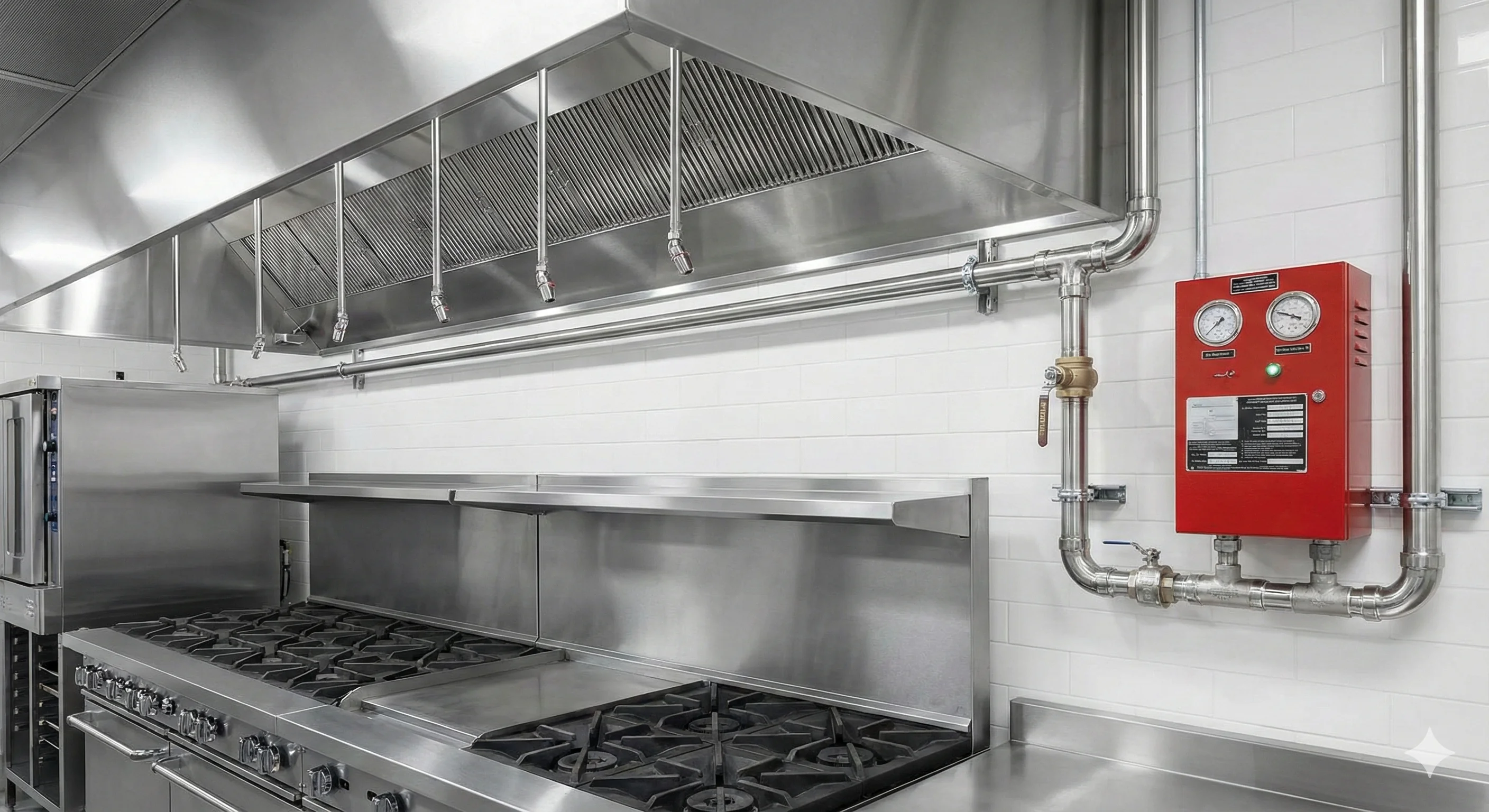
Why Commercial Kitchens Need Dedicated Fire Suppression
Commercial kitchen fires behave differently than fires in other building spaces. Cooking equipment reaches temperatures that can ignite cooking oils. The exhaust duct above the cooking line collects grease with every service.
How kitchen fires start
When a fryer overheats, a wok flame hits a greasy filter, or ventilation fails, fat vapour concentrates in the duct. The result is a fast, intensely hot fire.
Water cannot safely extinguish these fires.
Why water is dangerous
Water on burning cooking oil causes an explosive steam reaction. This projects burning droplets across the entire kitchen instantly.
This is why DCD regulations prohibit water-based sprinklers over cooking equipment.
The correct solution: wet chemical suppression
Wet chemical suppression uses a potassium-based agent. It extinguishes flames through saponification.
This creates a foam blanket over the oil surface that seals off oxygen. It also cools the fuel below re-ignition temperature.
Every restaurant owner, hotel kitchen manager, and catering operator in Dubai must understand this distinction.
How Kitchen Hood Suppression Systems Work
The ANSUL R-102 is the most widely installed and DCD-accepted kitchen hood fire suppression system in the UAE. Johnson Controls manufactures this pre-engineered wet chemical system. Certified UAE contractors distribute it.
What the system protects The system integrates directly with the exhaust hood assembly. It protects:
- Deep fat fryers
- Griddles
- Open-flame burners
- Wok stations
- Charbroilers
- Exhaust ducts
- Grease filters
It covers every component of the cooking line where ignition is a realistic risk.
How the system operates The system uses:
- Stainless-steel actuation lines
- Temperature-sensitive fusible links
- Discharge nozzles
- A pressurised agent cylinder
The discharge sequence
When a fusible link in the hazard zone reaches its rated temperature (typically 182 C or 260 C), it melts and releases the actuation mechanism.
Agent discharges through nozzles directly onto cooking equipment and into the exhaust duct.
Simultaneously:
- An automatic gas shut-off valve cuts fuel to all protected appliances
- An audible alarm alerts kitchen staff
- The building fire alarm panel triggers through a micro-switch interface
The entire discharge sequence completes in seconds.
Post-discharge requirements The saponification reaction with cooking oil produces a stable foam blanket. This prevents re-ignition as equipment cools. After discharge, the kitchen cannot resume operation until a qualified technician:
- Inspects the system
- Cleans the system
- Recharges the system
- Re-certifies the system
This requirement highlights the importance of having a responsive service contractor available at short notice.
DCD Requirements and Maintenance Standards
Who needs a system? Dubai Civil Defence requires kitchen hood suppression systems in all commercial kitchens above domestic scale. This includes:
- Restaurants
- Hotel kitchens
- Hospital canteens
- School cafeterias
- Food courts
- Catering operations
Installation requirements
The system must be designed by a DCD-approved contractor. Full shop drawings must be submitted for DCD plan approval before installation begins.
All nozzle types, coverage areas, and agent quantities must match the manufacturer's specifications. A manufacturer-certified or DCD-licensed technician must carry out the installation.
Maintenance schedule
Kitchen suppression systems require more frequent maintenance than other fire systems. The aggressive operating environment demands this attention.
DCD and the ANSUL manufacturer programme both require semi-annual service every six months. Most other fire systems only need annual service.
Each service visit must include:
- Visual inspection of all nozzles, nozzle caps, and blow-off caps
- Replacement of all fusible links (mandatory at every service)
- Cylinder pressure check and agent weight verification
- Inspection and testing of the gas shut-off valve
- Review of grease accumulation in the duct and on cooking surfaces
- Testing of all electrical interlocks and alarm interfaces
- Issue of a signed service report for DCD records
Fusible link replacement
Fusible links must be physically replaced at every six-month service. You cannot simply inspect and retain them.
A link that looks intact may have been heat-weakened during service. It will not actuate reliably.
This is not optional it is a mandatory manufacturer requirement and a DCD compliance item.
What Happens Without a Compliant System
Regulatory consequences
Operating a commercial kitchen without an approved suppression system creates rapid consequences.
Dubai Civil Defence will not issue or renew a Civil Defence safety certificate for premises lacking required fire protection. Without a valid certificate:
- Your trade licence cannot be renewed
- Your DTCM restaurant or hotel permit cannot be maintained
- Health authority approvals may be denied (they increasingly cross-reference fire safety compliance)
Financial risks
The financial exposure from an unprotected kitchen fire is severe. Total loss of a restaurant fit-out in Dubai routinely exceeds AED 500,000. This includes:
- Commercial kitchen equipment
- Front-of-house furnishings
- Structural repairs
Most UAE commercial property insurers include kitchen suppression requirements as a condition of cover. An unprotected fire incident leaves the business owner personally liable for the entire loss.
Frequently Asked Questions
Q: Is a kitchen hood suppression system mandatory for all commercial kitchens in Dubai? Yes. DCD requires an automatic fire suppression system beneath the exhaust hood of every commercial kitchen that produces grease vapours. This applies to:
- Restaurants
- Hotel kitchens
- Hospital and school catering
- Food courts
- Any professional cooking operation
The requirement applies regardless of kitchen size or the number of cooking appliances.
Q: How often does a kitchen suppression system need to be serviced in the UAE?
Every six months, without exception. Semi-annual service is mandatory under both DCD requirements and the ANSUL manufacturer programme.
All fusible links must be physically replaced at each service visit not just inspected. A service report signed by the licensed technician must be kept on file and shown to DCD inspectors.
Q: What should I do immediately after my kitchen suppression system discharges? Stop all cooking operations immediately. Do not restart equipment until the system has been professionally serviced. Call your licensed suppression system contractor for an emergency call-out. The system must be:
- Fully inspected
- Cleaned
- Recharged with fresh agent
- Have all fusible links replaced
The kitchen can legally resume operation only after these steps. QSERV provides 24-hour emergency response for post-discharge restoration across Dubai and the UAE.
Explore the Kitchen Fire Protection Cluster
Each page below goes deeper on one part of protecting a Dubai commercial kitchen.
For broader services, see QSERV's Fire Systems AMC Dubai and Kitchen Hood Suppression Dubai pages.


